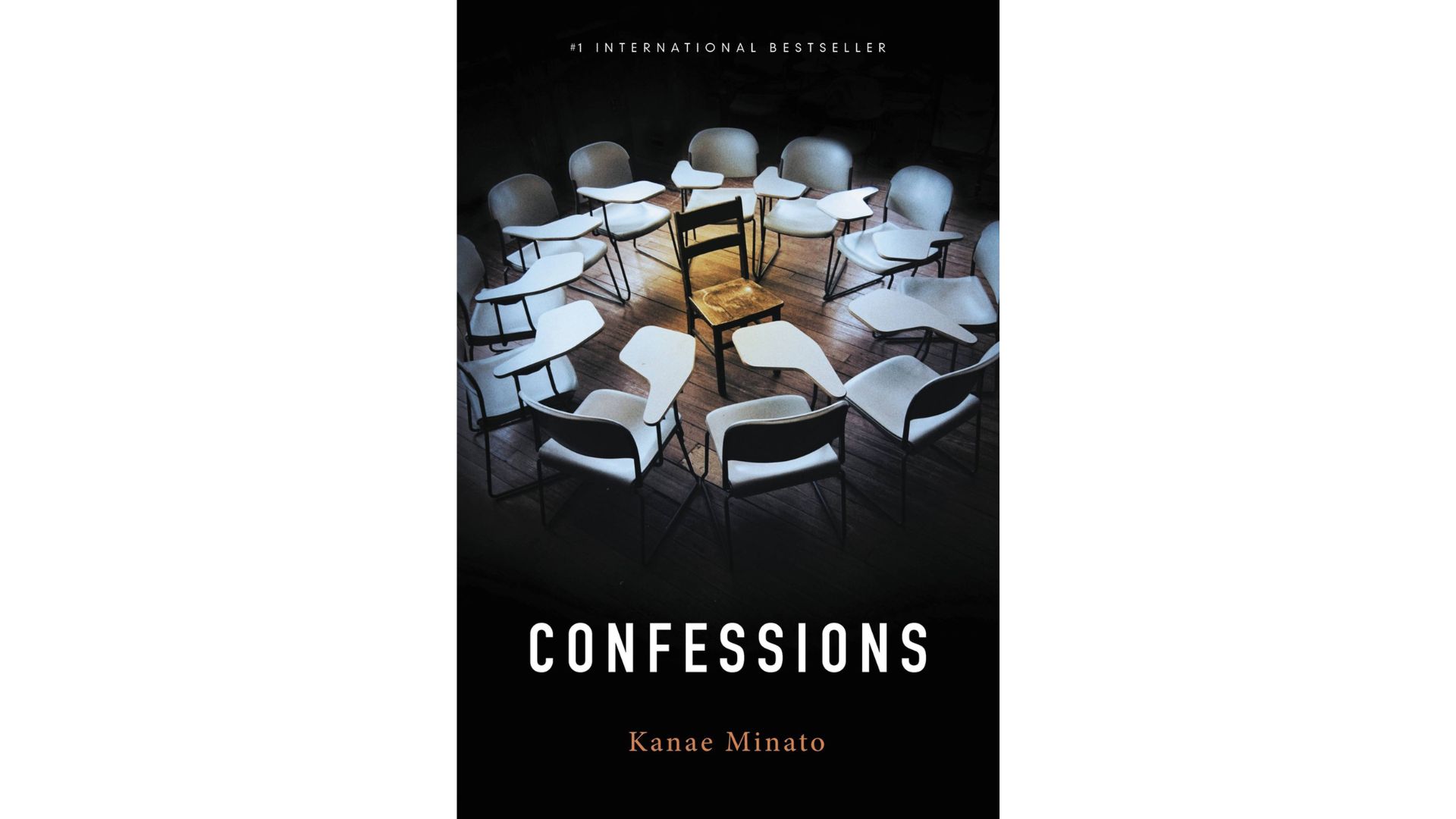
When I reviewed Confessions, I said there are books that stay with you for a few days, and then there are books like this one. So naturally, the next question was: could a film possibly be as unsettling as the book?
Welcome back to From Pages to Screen, where I compare a book with its adaptation (last time it was The Witcher). This time we’re heading to Japan, for one of the darkest revenge stories I’ve ever read, and the film that turned it into an awards contender.
This post is spoiler free, for both the book and the movie.
The book: Confessions (2008)
Kanae Minato’s debut novel opens on the last day of the term. A middle-school teacher, Yuko Moriguchi, addresses her class and calmly tells them that her young daughter’s death was not an accident. And that two students in the room are responsible, and what she has done about it.
That’s chapter one. Every chapter after it is told by a different narrator, each one “confessing” their side, and each one changing how you see everything before.
The novel was a huge success in Japan, winning the 2009 Japan Booksellers’ Award, and reached English readers in 2014 in a translation by Stephen Snyder. I gave the novel 5 Muse points. It’s one of the most brilliantly structured psychological crime novels I have ever read. And the opening chapter left my jaw on the floor. Don’t start if you have things to do, because you won’t stop.
The film: Confessions (2010)
The film, released in Japan in 2010 as Kokuhaku, was directed by Tetsuya Nakashima and stars Takako Matsu as Moriguchi. It was a major hit at home, won Best Picture at the 34th Japan Academy Film Prize, and was Japan’s submission for the Academy Award for Best Foreign Language Film, making the shortlist.
Nakashima’s style is very different from the book’s quiet and cold voice. He used slow motion, rain, washed-out blue-grey colours and a pulsing soundtrack. It looks more like a music video than a classroom drama, and somehow that works. I loved that washed-out style. It’s easy to see why the film has such a devoted following.
Book vs Film: What changes?
The Structure
The book is built on separate monologues, one narrator per chapter. The film keeps those multiple perspectives and follows the book almost scene by scene.
This is one of the most faithful adaptations I’ve seen. If you’ve read the book, you’ll recognise nearly every moment.
The opening confession
The teacher’s opening speech is the heart of both. In the book, you read it as one long, chillingly calm monologue. On screen, Takako Matsu delivers it to a noisy, distracted class, which grows silent as the speech goes on. The contrast makes it even colder.
The opening scene is as powerful as it is in the book, in my humble opinion. The only thing different from my imagination was some of the students’ reactions.
The tone
The book feels clinical and quiet, which makes the cruelty more shocking. The film is stylised and almost dreamlike. Some viewers find that this makes the violence feel distant. Others find it more haunting.
I’m firmly in the “more haunting” camp. The reconstruction of the two students’ scene with the teacher’s little daughter at the pool looked exactly the way I’d pictured it in the book.
The ending
No spoilers, but this is the one place where the film falls short for me. The book’s ending is more powerful. I suspect it’s simply because the complex scene is very hard to put on screen.
Which should you experience first?
| If you… | Start with |
|---|---|
| Love getting inside characters’ heads | The book |
| Want the full slow-burn effect of each reveal | The book |
| Prefer visual, atmospheric storytelling | The film |
| Only have two hours tonight | The film |
My recommendation is to read the book first. The film is a beautiful, faithful adaptation, but the book’s ending hits harder, and you’ll enjoy spotting how closely the film follows it.
Content warning: both the book and the film deal with the death of a child, bullying, violence, and revenge. Neither is graphic, but they’re dark, and it’s worth knowing that going in.
If you liked Confessions…
- 8 Books Like The Silent Patient: more twisty psychological thrillers.
- What Is Honkaku?: a very different side of Japanese crime fiction.
- Best Mystery Books Set in Japan.
Have you seen the film? Did it live up to the book for you? Tell me in the comments.