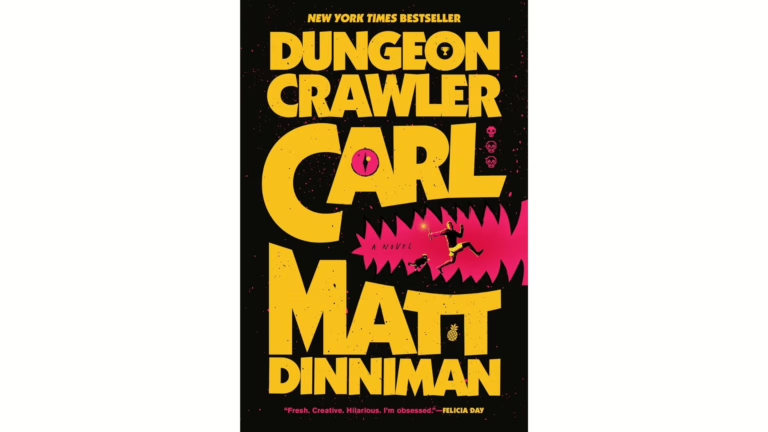
If you’ve ever tumbled down the rabbit hole of Dungeon Crawler Carl by Matt Dinniman, you already know the particular madness it induces. You read one chapter before bed. You look up. It’s 3am. Carl and Donut are still in your head, narrating everything with snark and heart, and you are absolutely not okay about it.
LitRPG and GameLit fantasy occupies a fascinating corner of the genre landscape. These are stories where the world operates on game mechanics, where characters gain experience points, level up, and navigate systems that are equal parts brutal and absurd. Done poorly, it feels like reading someone else’s character sheet. Done brilliantly, it delivers propulsive plotting, unexpectedly sharp social commentary, and protagonists you’d follow into any dungeon. Dungeon Crawler Carl sits at the pinnacle of that second category, and once you’ve finished it (or, more accurately, once you’ve inhaled every currently published volume), the hunger for something equally good is very real.
I’ve spent a considerable amount of time in this genre, sorting the genuinely compelling from the formulaic. The five books below each bring something distinct to the table: sharp wit, world-building ambition, emotional depth, or some delicious combination of all three. Whether you’re a seasoned LitRPG reader or someone who stumbled in through Carl’s cat-shaped door, there’s something here for you.
5 LitRPG and GameLit Books That Scratch the Dungeon Crawler Carl Itch
The Land: Founding by Aleron Kong
Often cited as one of the founding texts of Western LitRPG, The Land: Founding introduces Richter, a young man pulled into a fantasy world that operates entirely on game logic. He has a status screen, skill trees, and a whole continent that seems determined to kill him before he figures out how any of it works.
What makes this one hold up is the sheer enthusiasm of its world-building. Kong clearly loves his creation, and that energy is infectious. The progression system is meaty and satisfying, the kind where you actually want to stop and read every stat upgrade. It lacks some of the razor-sharp wit of Dinniman’s work, but it compensates with genuine scope and a pace that rarely lets up.
If you want a series you can really sink into, this is a strong starting point. The series runs long (very long), which is either a blessing or a warning depending on your reading habits.
He Who Fights With Monsters by Travis Deverell
This series began as web fiction and has since made the leap to traditional publishing, which tells you something about the quality. Jason, the protagonist, is transported to a world where adventuring is a profession governed by rigid class and power hierarchies. He is, predictably, from the wrong side of them.
What sets this one apart is its tonal balance. It’s funny, genuinely funny, without sacrificing the tension of its action sequences or the coherence of its magic system. The social dynamics of the world feel thought-through rather than convenient, and the supporting cast earns their page time. There’s a dry observational humour here that will appeal strongly to fans of Carl’s narrative voice.
The progression is satisfying without being obsessive about numbers, a balance that’s harder to strike than it looks. A very easy recommendation for readers making their first foray beyond Dinniman.
Beware of Chicken
This one is genuinely unlike anything else on this list, and I mean that as the highest possible compliment. Beware of Chicken begins as a cultivation (xianxia) story parody and becomes something much warmer and stranger than that description suggests. Jin Rou, a young man transported into a cultivation world, decides he has absolutely no interest in becoming an all-powerful martial arts legend. He wants to farm.
The game mechanics here are gentler and more embedded in the fabric of the story rather than foregrounded as flashy number-crunching. What it shares with Dungeon Crawler Carl is a commitment to finding the emotional core inside an absurd premise. The animal characters, particularly Bi De the rooster, are genuinely moving in ways you will not see coming.
It’s cozy and funny and occasionally devastating. A necessary palate cleanser between more intense dungeon-crawling experiences.
Dungeon Born by Dakota Krout
Here’s a clever inversion: instead of following someone navigating a dungeon, Dungeon Born follows the dungeon itself. Dale, a novice adventurer, provides the human perspective, but the real protagonist is Cal, a consciousness who has awakened inside a dungeon core and is figuring out how to grow, evolve, and survive the adventurers who keep trying to loot him.
The premise sounds gimmicky, and Krout earns every bit of its execution. The dungeon-building mechanics are absorbing, and watching Cal develop something like personality and motivation makes the story far more emotionally engaging than it has any right to be. There’s a deadpan comedy to Cal’s perspective that fans of Carl’s narrative voice will appreciate immediately.
The series is long and the quality does fluctuate across volumes, but the first book is a tight, inventive premise executed with real confidence.
The Wandering Inn by Pirateaba
Calling The Wandering Inn a book slightly undersells it. It began as one of the longest-running web serials in the English language and has since been published in formatted volumes. Erin Solstice falls into a game-like world and, rather than becoming a hero, opens an inn. The story sprawls magnificently from there.
There is almost nothing else in any genre that reads like this. It’s enormous, yes, and the early chapters take time to find their rhythm, but the world Pirateaba has built is staggeringly alive. Characters accumulate histories. Factions shift. The game mechanics serve a genuinely literary purpose, measuring growth and change in ways that illuminate character rather than just reward it.
It demands patience and commitment. What it gives back is something close to inhabiting a world rather than just reading about one. Fans of Carl who want that same sense of a universe with rules, stakes, and strange beauty underneath the chaos will find a great deal to love here.
If you enjoyed this list, you might also want to check out Dungeon Receipt: Guardian’s Path, a debut LitRPG featuring a cowardly dungeon crawler who discovers that dungeon has a shop.

Final Thoughts
The best LitRPG and GameLit fiction does something that matters: it uses the familiar architecture of games to tell stories about agency, identity, and the strangeness of systems, and it does so with energy and invention. Dungeon Crawler Carl is brilliant precisely because it never forgets the human being inside the mechanics. The books on this list, each in their own way, share that commitment.
Whether you start with the warmth of Beware of Chicken, the epic ambition of The Wandering Inn, or the sharp comedy of He Who Fights With Monsters, there’s no wrong door in. I’d love to know which ones you’ve already read, which ones you’re planning to pick up, and whether there are titles you think deserve a spot on this list. Drop a comment below and let’s talk books.
Find all these books at Bookshop.org — every purchase supports independent bookstores.